
About ECSA
Primary School
- C&C Glossary Terms Year 5 [Worksheet]
- Learning about elections Year 5 C&C [Lesson Plan]
- Year 5 C&C AC Election Links
- Linking SA elections to the Australian curriculum

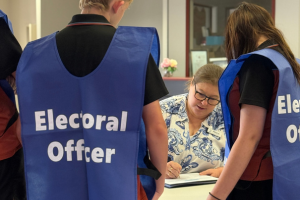
After each state election and by-election, ECSA produces a report which is tabled in Parliament and made publicly available. The reports cover all aspects of an election, including a summary of the results.
Detailed results are made available in statistics reports, or on our past state election results page.
- 2024 Dunstan and Black By-election Report (PDF)
- 2024 Dunstan By-election Electors Survey Report (PDF, 808KB)
- 2022 SA State Election and Bragg By-election Report (PDF, 4.1MB)
- 2022 SA State Election and Bragg By-election Report - Recommendations (PDF, 1.9MB)
- 2022 SA State Election and Bragg By-election Report (HTML)
- 2022 State Election Electors Survey Report (PDF, 3.2MB)
- 2019 Cheltenham and Enfield By-Elections Report (PDF, 9.8MB)
- 2019 Electors Survey Report (PDF, 859KB)
- 2018 State Election Report (PDF, 13.7MB)
- 2018 State Election Report (HTML)
- 2018 State Election Statistics Report (PDF, 18MB)
- 2018 Electors Surveys Report (PDF, 2.7MB)
- 2018 State Election Service Charter (PDF, 3.7MB)
- 2014 State Election Report including Fisher and Davenport by-elections (PDF, 7MB)
- 2014 State Election Statistics (PDF, 11.9MB)
- 2012 Port Adelaide and Ramsay By-Elections Report and Statistics (PDF, 3.4MB)
- 2010 State Election Report (PDF, 3.8MB)
- 2010 State Election Statistics (PDF, 9.7MB)
- 2009 Frome By-Election Report and Statistics (PDF, 1.9MB)
- 2006 State Election Report (PDF, 3.6MB)
- 2006 State Election Statistics (PDF, 7.4MB)
- 2002 State Election Report (PDF, 1.9MB)
- 2002 State Election Statistics (PDF, 7.5MB)
- 1997 State Election Report (PDF, 1.2MB)


Brochures, guides and videos
A wide range of accessible material designed to inform and educate.

Research reports
Research publications are presented in a variety of different formats, including:

Other corporate publications
We produce other corporate publications that deal with the strategic and operational aspects of ongoing activities.

Council elections
After periodic elections the Electoral Commission of South Australia produces a report covering all aspects of the elections, including a summary of the results.

State elections and by-elections
After each state election and by-election, ECSA produces a report which is tabled in Parliament and made publicly available. The reports cover all aspects of an election, including a summary of the results.
For further information
The Freedom of Information Act 1991 (the Act) gives members of the public a legally enforceable right to access information held by the South Australian Government, subject to certain conditions.
Application for access
Applications for access or amendments to documents under the Act must be in writing. Online applications can be made via SA.GOV.AU. Alternatively you can make an application via a letter or email accompanied by the relevant application form available via the State Records of South Australia website.
Applications for access or amendments to documents must:
- specify that the application is made under the Freedom of Information Act 1991
- be accompanied by the statutory fee (by cheque, money order or cash)
- Exemptions apply for concession holders or for applicants that can demonstrate financial hardship
- Additional charges may be levied in processing a request, dependent on the nature and complexity
- clearly identify the documents being sought or the matter to which they relate
- state whether the application is for access or amendment of documents
- state whether the documents contain information of a personal nature
- specify the applicants address
- specify the method of access to the document, such as inspection at an arranged time and location, or having a hard or electronic copy provided.
Written application not made online via the State Records portal should be addressed to:
Accredited Freedom of Information Officer
Electoral Commission SA
GPO Box 646
Adelaide SA 5000
Or email:
Electoral Commission SA will acknowledge all Freedom of information (FOI) applications within 2 business days.
A determination is generally made within 30 days of receipt however in some cases an extension may be granted and this will be advised in writing.
Further information
Any enquires about FOI applications can be directed to 1300 655 232 during business hours or by email to
Further detail on the FOI process and application forms can be found on the State Records for South Australia website.
Internal review
If you are not satisfied with a determination, you can request an internal review. The application to review a decision under FOI form can be found via the State Records Website.
The application to request an internal review form should be sent with the statutory fee to the principal officer within 30 days of receiving your determination.
Application fees and charges are located on the State Records Website.
Applications for an internal review should be forwarded to:
Electoral Commissioner
Electoral Commission SA
GPO Box 646
Adelaide SA 5000
Or email:
External review by the Ombudsman
After an internal review is completed and you are not satisfied with the decisions, or where you have been unable to apply for an internal review, you can apply for an external review by the Ombudsman.
You may also request an external review by the Ombudsman if you have no right to an internal review.
The application for review by the Ombudsman should be lodged within 30 days after the date of a determination. The Ombudsman’s office, at their discretion, may extend this time limit.
Investigations by the Ombudsman are free. For further information contact:
- Phone: 8226 8699
- Phone: 1800 182 150 (toll free, within SA)
- Visit the OmbudsmanSA website.
Appeal to the South Australian Civil and Administrative Tribunal (SACAT)
If you are not satisfied with the decision made by Electoral Commission SA or after a review by the Ombudsman, you can appeal to SACAT.
You must exercise your right of review to SACAT within 30 calendar days after being advised of the determination or the results of the review. Any costs will be determined by SACAT, where applicable.
For further information contact:
- Phone: 1800 723 767
- Email:
This email address is being protected from spambots. You need JavaScript enabled to view it. - Visit the South Australian Civil and Administrative Tribunal (SACAT) website.