
ECSA
The descriptions of terms in this glossary are for quick reference only. This glossary is not to be substituted for the formal definitions found within the legislation. Refer to the Electoral Act 1985 (the Act).
Accessible Format; Information provided in ways that meet diverse needs, including Easy Read, large print, audio, captioned video, screen reader compatible digital content, and translated materials.
Accessibility; We work closely with our communities to make voting as accessible as possible. For example, in State Elections, every polling booth is assessed for disability access, and we prioritise choosing fully accessible venues wherever we can.
Standard Accessible Rankings for Polling Locations
 Fully accessible means that a person in a wheelchair can independently enter and exit the booth
 Assisted access means that a person in a wheelchair may not be able to independently enter and exit the booth, and assistance may be required.
  No accessibillity options.
The State Election Hidden Disability Support (Sunflower Lanyard)  meant electoral officers aided electors in a discreet manner. Our Inclusive locations
  were selected early voting centres in a pilot program designed to reduce barriers for people with hidden disabilities, as well as parents with children who need lower‑stimulus environments.
Active Participation; The ability for people with disability to engage independently and meaningfully in civic, community, workplace and democratic processes, including enrolling and voting.
Assistive Support; Practical assistance provided to enable a person with disability to participate fully, such as staff support, accessible voting tools, or Telephone Assisted Voting, while respecting voter independence and privacy.
Carer; A person who provides care or support to a person with disability, illness, mental ill health or ageing related needs.
Culturally Safe; An environment that is spiritually, socially and emotionally safe for people, where there is no assault, challenge or denial of identity, particularly for Aboriginal and Torres Strait Islander peoples.
Democracy; a way of governing where the people have a say in how things are run.
Disability; As defined under the Disability Inclusion Act 2018 (SA), disability may be physical, sensory, intellectual, cognitive, neurological or psychosocial, and may be visible or non visible.
Disability Access and Inclusion Plan (DAIP); A strategic plan required under the Disability Inclusion Act 2018 (SA) that outlines how an organisation will improve access, inclusion and participation for people with disability.
Disability Engagement Advisory (DEA) Committee; A consultative body comprising disability organisations and advocates that provides advice to ECSA on accessibility, inclusion, service design and barriers to electoral participation.
- Blind Citizens Australia SA
- Catalyst Foundation
- CanDo Group (previously Deaf SA)
- JFA Purple Orange
- Mental Health Coalition of South Australia
- Multiple Sclerosis Society of SA/NT (MS)
- Office of the Public Advocate
- Office for Autism (and Autism SA)
- SeeDifferently (previously RSB)
Over time, the meaning of donkey vote shifted significantly. According to the Oxford English Dictionary, the modern electoral meaning has been in use since 1955 and is defined as:
Easy Read; Information presented using plain language, short sentences, supportive images and clear layout to assist people with intellectual disability, cognitive impairment or low literacy.
Election; a special event where people vote to choose their representatives.
Elector; a person who can vote in an election
Hidden (Non visible) Disability; A disability that is not immediately apparent, such as autism, mental ill health, neurological conditions, sensory processing differences, chronic illness or learning disability.
Hidden Disabilities Sunflower Lanyard Program; A voluntary program that allows people with non visible disabilities to discreetly indicate they may need additional support, patience or understanding.
Inclusive Voting Centre / Inclusive Location; A voting location designed to reduce physical, sensory, cognitive or environmental barriers, for example through low sensory settings, clear signage, calm environments and trained staff.
Parliament; where elected representatives meet to discuss and make laws.
Preferential Voting; a way of voting where you rank your choices in order of preference.
Reasonable Adjustment; A change or modification that enables a person with disability to participate on an equal basis, provided it does not impose unjustifiable hardship (for example modified duties, flexible arrangements or alternative communication methods).
SECRET BALLOT; a way of voting where you write your choice down privately
Self Determination; The right of people with disability to make decisions about their own lives, including how they participate in voting, employment and community activities.
Telephone Assisted Voting (TAV); A voting method that allows eligible electors who are blind, vision impaired or unable to vote without assistance due to motor impairment to vote with support via a secure telephone process.
Voter Confidence; A voter’s trust and comfort in understanding the voting process, knowing what to expect, and feeling safe, respected and independent when participating in an election.
Back to top
At the close of nominations at 12 noon on Thursday 7 August 2025, the following elections accepted the candidate nominations that are listed on their respective election pages in the order in which they will appear on the ballot paper:
- Town of Gawler, Mayor
- Yorke Peninsula Council, Mayor
- District Council of Orroroo Carrieton, Area Councillor
- Adelaide Hills Council, Ranges Ward
- Adelaide Hills Council, Valleys Ward
- City of Norwood Payneham & St Peters, St Peters Ward
- Mount Barker District Council, South Ward
Campaign disclosure returns
Candidates must lodge the following returns with the Electoral Commissioner:
Campaign donation return
Return no. 1 – lodgement from Friday 15 August to Thursday 21 August 2025
Return no. 2 – within 30 days of the conclusion of the election
Large gift return
Return lodgement within 5 days after receipt, only required for gifts in excess of $2,500
Detailed information about candidate disclosure return requirements can be found at www.ecsa.sa.gov.au
Voting conducted by post
The elections are conducted entirely by post and no polling booths will be open for voting.
Ballot papers and reply-paid envelopes are mailed out between Tuesday 26 August and Monday 1 September 2025 to every person, body corporate and group listed on each voters roll at the close of rolls on 5pm, Monday 30 June. Voting is voluntary.
A person who has not received voting material by Thursday 4 September 2025, and believes they are entitled to vote, should contact the deputy returning officer on 1300 655 232 before 5pm, Monday 15 September 2025.
Completed voting material must be sent to reach the returning officer no later than 12 noon on polling day Monday 22 September 2025.
Assisted voting
Prescribed electors under section 41A(8) of the Local Government (Elections) Act 1999, may vote via the telephone assisted voting method by calling the Electoral Commission SA on:
1300 655 232 within South Australia only
08 7424 7400 from interstate
+61 8 7424 7400 from overseas
The Telephone Assisted Voting Centre will operate for the following times and days:
9am – 5pm, Thursday 18 September and Friday 19 September 2025
9am – 12 noon, Monday 22 September 2025 (close of voting)
Vote counting location
The scrutiny and counts will take place from 9:30am on Tuesday 23 September 2025 at the following location:
Electoral Commission SA Central Processing Centre
7 Hudson Court Netley 5037
A provisional declaration will be made at the conclusion of each election count.
Mick Sherry
RETURNING OFFICER

For further information
This email address is being protected from spambots. You need JavaScript enabled to view it.
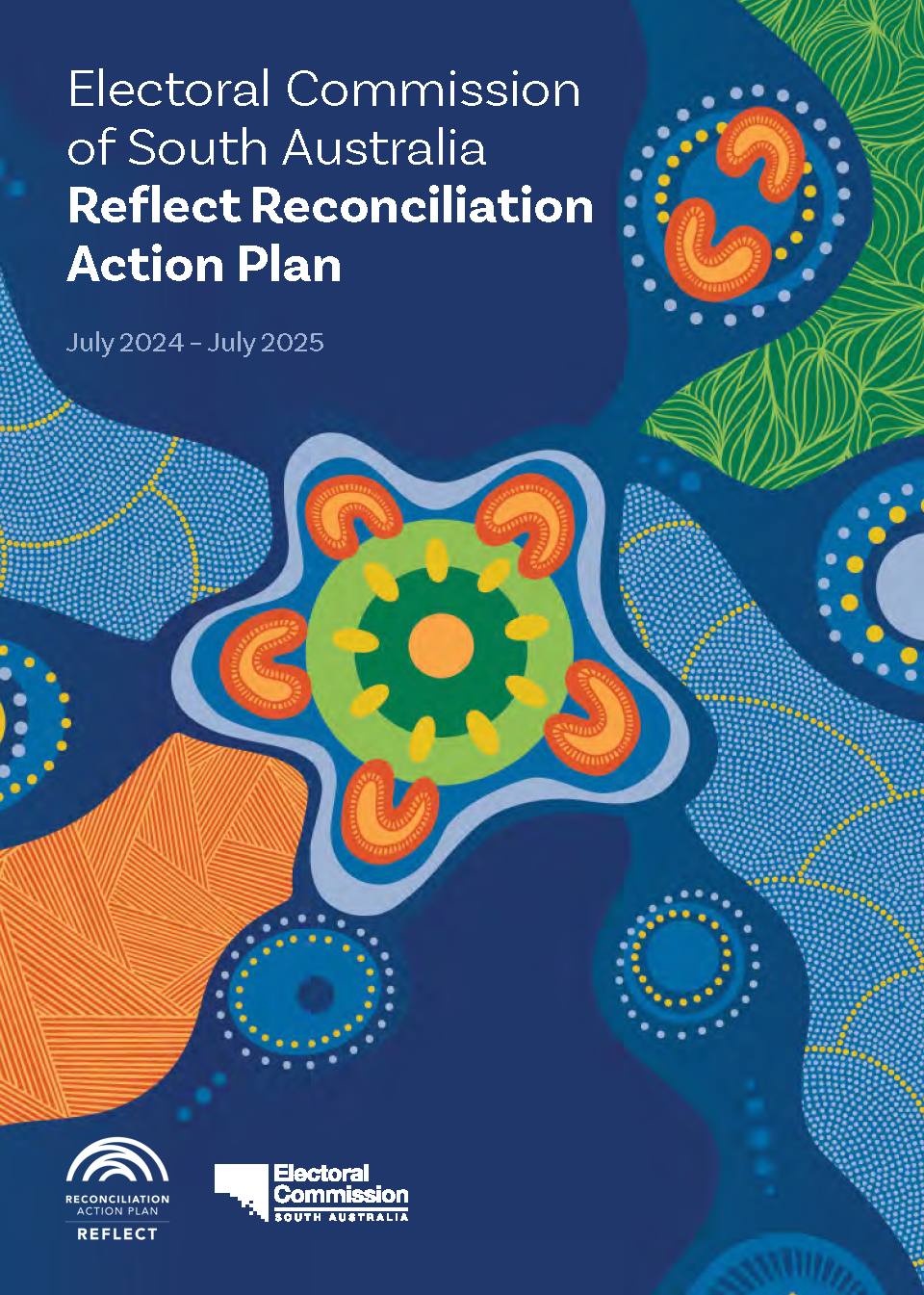
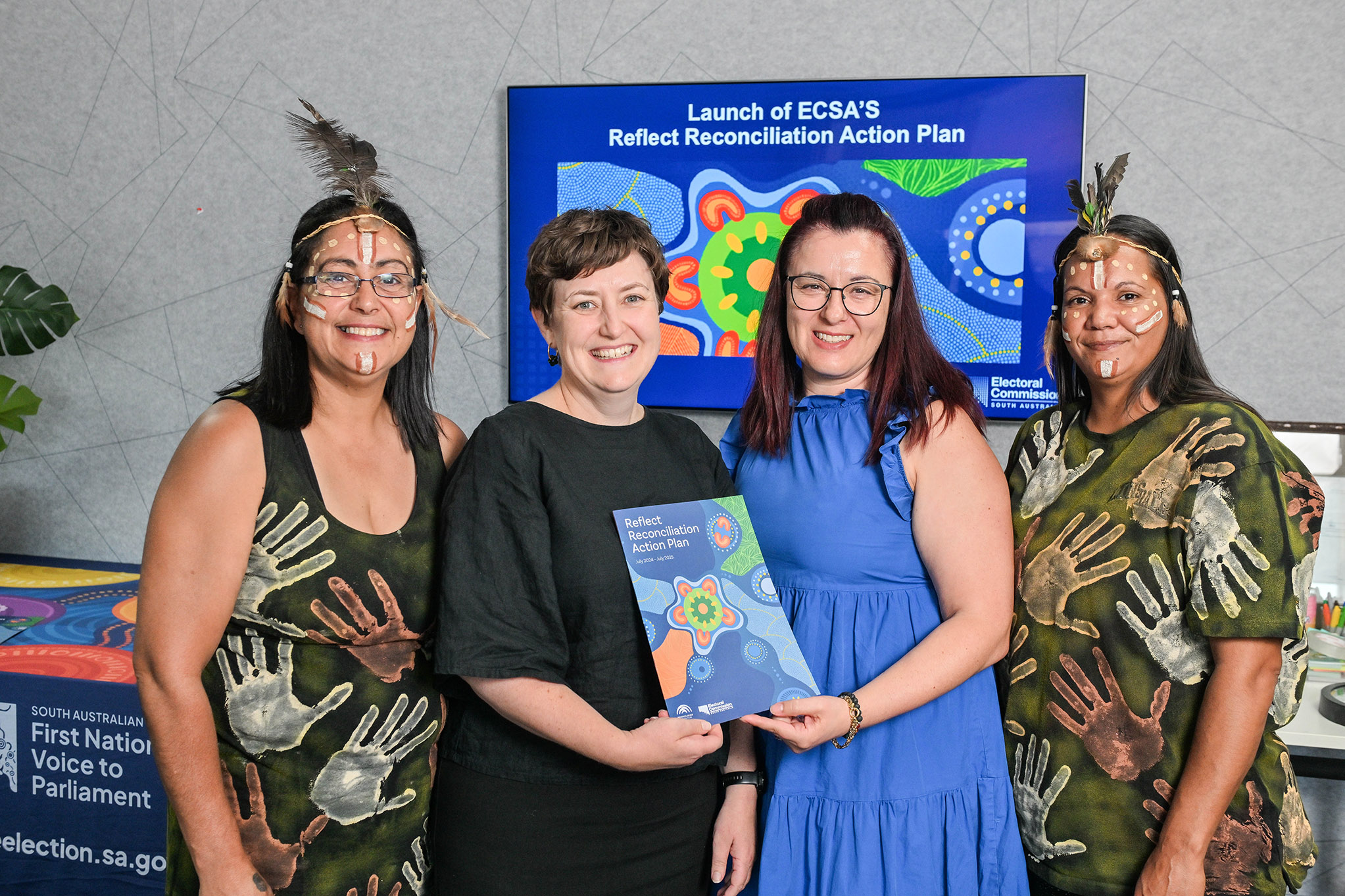
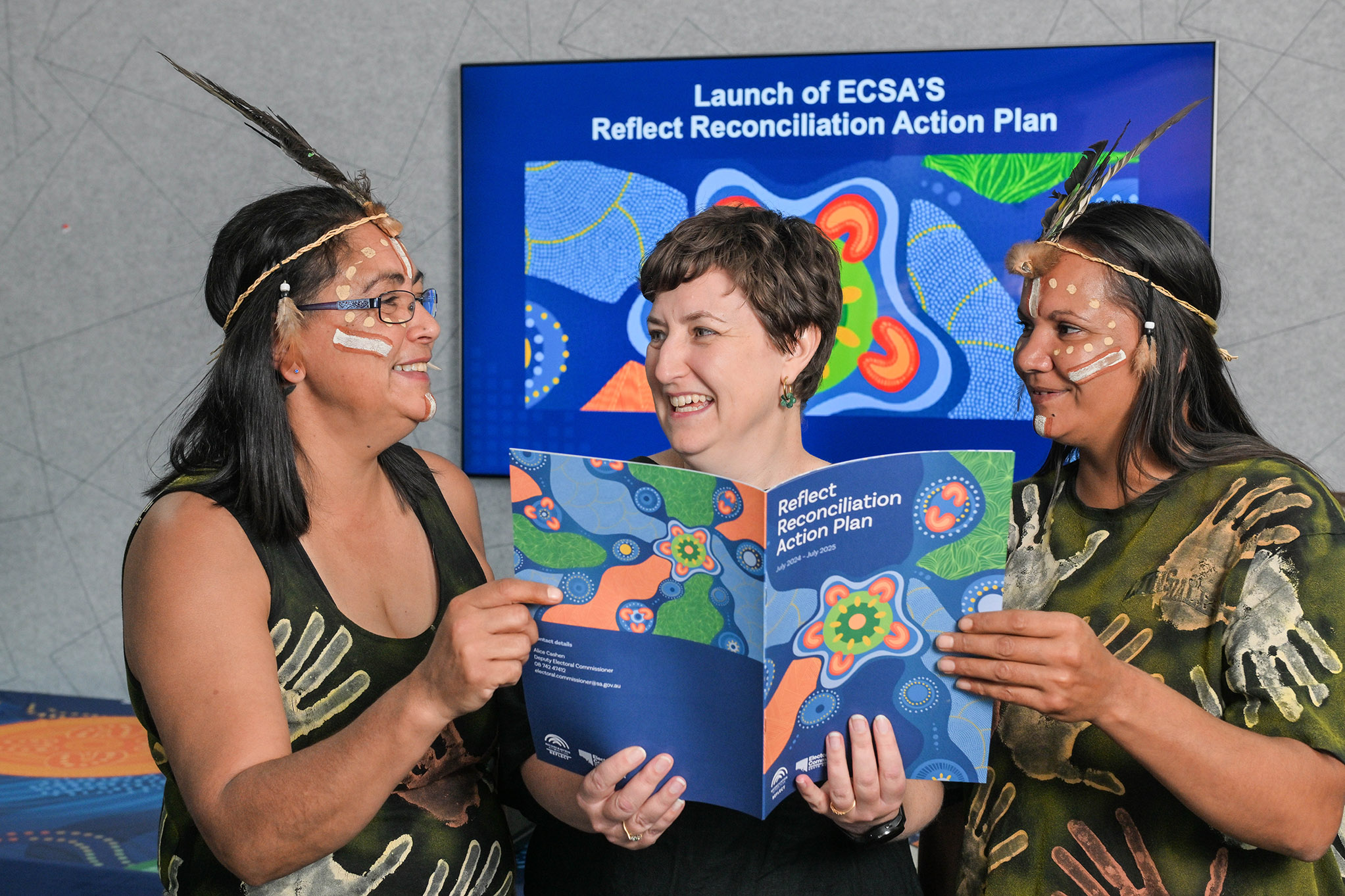
The Reflect RAP sets out ECSA’s commitment to reconciliation and the actions it will take to build the organisations understanding and recognition of Aboriginal and Torres Strait Islands cultures, histories, knowledge and rights.
This RAP is the starting point of ECSA’s reconciliation journey.
ECSA has a proud history of collaborating with Aboriginal and Torres Strait Islander communities throughout South Australia to ensure they can exercise their rights to participate in electoral events, including the APY Executive Board and the SA Local First Nations Voice to Parliament elections.
This Reflect RAP aims to build upon and consolidate these previous efforts, enshrining reconciliation as a core priority for ECSA in the lead-up to future State, Local Government, and other First Nations elections. It represents ECSA’s commitment to continually improving its effectiveness in working with diverse Aboriginal and Torres Strait Islander communities—whether remote, regional, or urban—and delivering electoral services that meet their needs.
...
Our partnerships / current activities
Over many years ECSA has been working with the various communities located in the Anangu Pitjantjatjara Yankunytjatjara (APY) lands in conducting their Executive Board elections.
...
Relationships
| Number | Action |
|---|---|
| 01 | Establish and strengthen mutually beneficial relationships with Aboriginal and Torres Strait Islander stakeholders and organisations. |
| 02 | Build relationships through celebrating National Reconciliation Week (NRW). |
| 03 | Promote reconciliation through our sphere of influence. |
| 04 | Promote positive race relations through anti-discrimination strategies and antiracism. |
...
Respect
| Number | Action |
|---|---|
| 05 | Increase understanding, value and recognition of Aboriginal and Torres Strait Islander cultures, histories, knowledge and rights through cultural learning. |
| 02 | Demonstrate respect to Aboriginal and Torres Strait Islander peoples by observing cultural protocols. |
| 03 | Build respect for Aboriginal and Torres Strait Islander cultures and histories by celebrating NAIDOC Week. |
...
Action
| Number | Action |
|---|---|
| 08 | Improve employment outcomes by increasing Aboriginal and Torres Strait Islander recruitment, retention and professional development. |
| 09 | Increase Aboriginal and Torres Strait Islander supplier diversity to support improved economic and social outcomes. |
| 10 | Establish and maintain an effective RAP Working Group (RWG) to drive governance of the RAP. |
| 11 | Provide appropriate support for effective implementation of RAP commitments. |
| 12 | Build accountability and transparency through reporting RAP achievements, challenges and learnings both internally and externally. |
| 13 | Continue our reconciliation journey by developing our next RAP. |
DOWNLOADABLE DOCUMENT