
Voting
In the lead-up to an election, trained and vetted Electoral Visitors are sent to these institutions to assist residents with casting their vote in person. This service usually runs from 9 am to 5 pm, Monday to Friday, during the week before polling day. In some cases, it may continue until 6 pm on polling day itself.
Residents who prefer to vote by mail can also apply for a postal vote.
Please note: this service is designed specifically for patients and residents of these institutions. It is not available to staff or visitors.
A proportional representation system of voting called single transferable vote is used to elect members of the Legislative Council. This system has been used in South Australia since 1975.
In order to win a seat in the Legislative Council, a candidate is normally required to obtain a ‘quota’ of the formal votes. This quota - or minimum number of votes required to win a seat – ensures that winning candidates are elected with a near equal numbers of votes.
Counting the votes for the Legislative Council is both slower and more complicated than the count for the House of Assembly. On election night only first preferences are counted, leaving the major part of the count – i.e. the calculation of the quota, the distribution of surplus votes and the exclusion of candidates - to the days after the election.
Five steps are followed to count the votes for the Legislative Council:
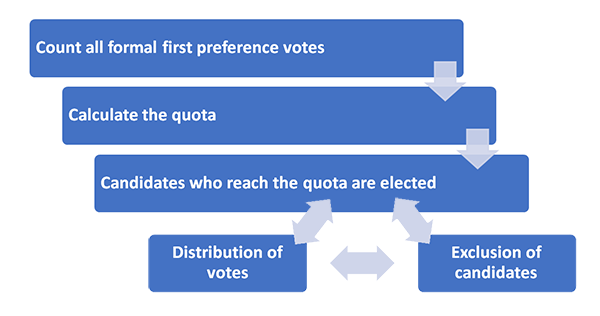
A detailed explanation of the steps involved can be found below.
1. Counting the first preference votes
The first step in the process is to sort the ballot papers into first preferences for each group above the line and below the line, as well as first preferences for each ungrouped candidate. The first preference figures are then transmitted to the media and published on the ECSA website.
Once all declaration votes have come in from across the state and around the world – which cannot take place until the final postal votes have been received seven days after polling day - the total number of formal (or valid) votes can be calculated. This number is essential for the second step in the process, calculating the quota.
2. Calculating the quota
To be elected to the Legislative Council, candidates need to gain a minimum number – known as a quota - of the total formal votes. This quota is calculated by dividing the total number of formal ballot papers by one more than the number of Legislative Council members to be elected, and then adding one to the result (disregarding any remainder).

3. Election of candidates who reach the quota
Candidates who receive a total of first preference (or number ‘1’) votes equal to or greater than the quota, are elected immediately.
It is possible, although very unusual, for this to lead to all the vacant seats being filled, and therefore, the election being finalised. It is much more frequent however, for the Electoral Commission to need to move on to the next two steps in the counting process.
4. Distribution of surplus votes
If any elected candidates received more votes than the quota, their surplus votes are distributed to the remaining candidates according to the further preferences indicated on the ballot papers.
Because it is not possible to determine which votes actually elected the candidate and which votes are surplus, all the elected candidate’s ballot papers are transferred at a reduced value called a ‘transfer value’.
The transfer value is calculated as follows:

As surplus votes are distributed, other candidates may be elected. However, if at any point all the surplus votes from elected candidates have been distributed and there are still positions left unfilled, the Electoral Commission proceeds with the next step in the counting process.
5. Exclusion of unsuccessful candidates
Starting with the candidate who received the lowest number of votes, unelected candidates are excluded from the count. The excluded candidate’s ballot papers are distributed to the remaining candidates based on preferences.
If any of the remaining candidates obtain a quota through this process of distribution, they are elected.
Their surplus votes (if any) are distributed before any other candidates are excluded. This process of distributing surplus votes from elected candidates and excluding the candidate with the fewest votes is continued until all vacant Legislative Council seats are filled.
Exhausted ballot papers
As a result of voting reforms before the 2018 State Election, the Legislative Council now has a partial preferential rather than fully preferential voting method. This inevitably leads to an increase in the number of votes that are ‘exhausted’ – i.e. ballot papers where no further preferences have been expressed. Once a vote has been ‘exhausted’, it must be set aside from the count.
Candidates elected without a quota
If, as a result of exhausted ballot papers, there are not enough votes left in the count to fill the remaining vacant seats, the candidate or candidates with the highest number of votes are elected regardless of whether they have reached the quota.
A majority system of voting and counting called preferential voting is used to elect members of the House of Assembly. Preferential voting was first introduced in South Australia in 1929.
In order to win a seat in the House of Assembly, a candidate is required to obtain an absolute majority (more than 50%) of the total formal votes cast in an electoral district.
If a candidate has a majority of the votes, the candidate is elected and no further counting is necessary. If no candidate receives the majority, the candidate with the least number of formal votes is ‘excluded‘ and that candidate's ballot papers are re-sorted to the other candidates according to the second preference shown on each ballot paper. The process of exclusions is repeated until one candidate gains more than half of the formal votes and is elected.
Each count continues until only 2 candidates remain, regardless of whether a candidate gains an absolute majority earlier in the count.
If in the final count 2 candidates have an equal number of votes, the matter is referred by the Electoral Commissioner to the Court of Disputed Returns where the Court may determine the validity of disputed ballot papers. If it then appears that the deadlock has been resolved, the Court must declare the appropriate candidate elected, if not, the Court must order a fresh election.
An example of how preferences work in the House of Assembly
Kate, Lyn, Tom and Steve stand for election.
They receive the following formal first preference votes:
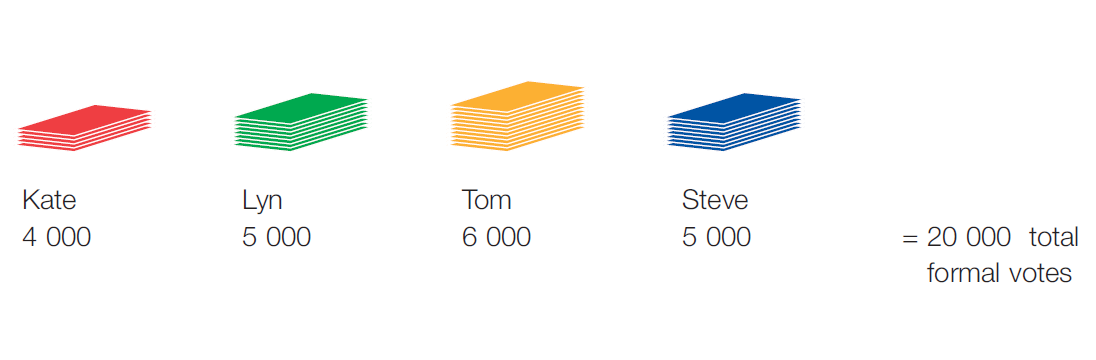
There are a total of 20,000 formal votes.
To be elected a candidate needs an absolute majority (more than 50% - or more than half of the vote)
As none of the candidates has gained an absolute majority of the votes (more than 10,000) at this first count, the candidate with the least number of votes (Kate) is excluded and her ballot papers are transferred to the other candidates according to which candidate was allocated the number 2 (second preference).
Kate’s votes are transferred as follows:
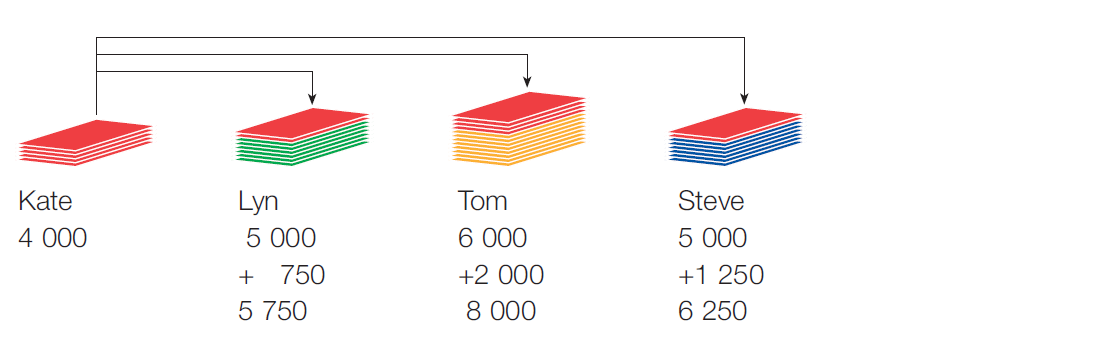
After Kate’s ballot papers have been distributed, neither Lyn, Tom, or Steve have gained an absolute majority. Lyn is now the candidate with the least number of votes so she is excluded and her ballot papers are distributed according to who was marked as the number ‘2’ (or the number ‘3’, if the ballot paper was previously transferred from Kate) preference.
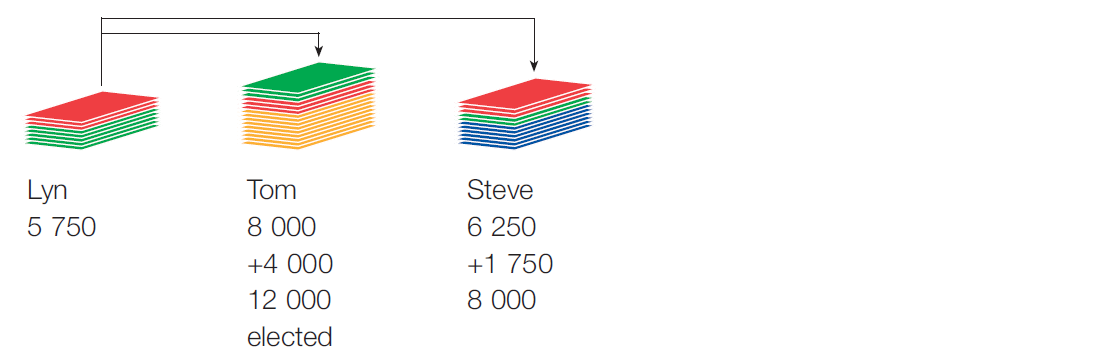
Once the preferences on Lyn’s ballot papers have been distributed (4,000 are marked for Tom and 1,750 for Steve) the ballot papers are totalled for each remaining candidate.
Tom now has more than half of the total votes cast (an absolute majority) and is declared the elected candidate.