
Parties and Candidates
Local Government Council Elections – Update
The next periodic local government council elections will now be held in April 2027 (previously scheduled for November 2026).
On this page
- Overview
- 2027 Council elections timetable
- Acts and regulations
- Candidate eligibility
- Nominating as a candidate
- Candidate responsibilities
- Forms and handbooks
- Responsibilities as a council member
Overview
This page outlines the key rules, responsibilities and requirements for standing as a candidate in South Australian council elections. It explains who is eligible to nominate, what disqualifies a person from being a candidate, and the obligations candidates must meet during the election period — including disclosure, advertising and conduct requirements.
The information is drawn from the Local Government (Elections) Act 1999, associated regulations, and relevant provisions of the Local Government Act 1999 and City of Adelaide Act 1998.
2027 Council elections timetable
- Rolls close — 5pm, Monday 4 January 2027
- Nominations open — Tuesday 26 January 2027
- Nominations close — 12 noon, Tuesday 9 February 2027
- Draw for ballot paper order — 9am, Wednesday 10 February 2027
- Candidate profiles published online — no later than Tuesday 23 February 2027
- Mail out of voting material — Thursday 11 March to Wednesday 17 March 2027
- Close of voting (polling day) — 5pm, Wednesday 7 April 2027
- Scrutiny and count — 9am, Saturday 10 April 2027
Acts and regulations
Council elections are governed by the following legislation:
- The Local Government (Elections) Act 1999
- The Local Government (Elections) Regulations 2025
- The City of Adelaide (Elections and Polls) Regulations 2025
These should be read together with the Local Government Act 1999 and the City of Adelaide Act 1998.
Candidate eligibility
Eligibility
Under Part 6 of the Local Government (Elections) Act 1999, you are eligible to stand as a candidate if you:
- are an Australian citizen, and
- at the time the electoral roll closes, you are:
- enrolled in the council area you are contesting, or
- the nominee of a body corporate on the voters roll, or
- the nominee of a group on the voters roll, or
- a person (or nominee of a body corporate or group) left on the roll in error.
Additional rules apply to nominees of bodies corporate and groups, including requirements relating to membership, officer status, age and the limit of one nomination per election.
Ineligibility
You are not eligible to be a candidate if you:
- are a member of an Australian Parliament
- are an undischarged bankrupt or receiving the benefit of a law for the relief of insolvent debtors
- have been sentenced to imprisonment and are, or could become, liable to serve the sentence or any remainder
- are an employee of the council
- are disqualified from election by court order under the Local Government Act 1999
- are suspended from office under section 55B of the Local Government Act 1999.
Additional restrictions apply:
- Supplementary elections: you cannot stand if you are a member of another council.
- Any election: you cannot stand if you are already a candidate for election as a member of another council.
Nominating as a candidate
To stand in a South Australian council election, eligible candidates must formally lodge a nomination with the returning officer during the nomination period. The rules for nominating are set out in Division 2 of the Local Government (Elections) Act 1999.
This section explains when nominations open and close, what must be lodged, and how nominations are published.
Lodging a nomination
A person who is eligible to be a candidate may nominate in the prescribed manner. Nominations can only be lodged from Tuesday 26 January 2027, and must be received no later than 12 noon on Tuesday 9 February 2027.
Your nomination must include:
- a declaration of eligibility
- a candidate profile that meets the requirements of the regulations (you may include a compliant photograph)
- any other information or material required by the regulations.
The returning officer records the date and time your nomination is received.
Candidate names
The returning officer may reject a nomination if the name under which you are nominated is:
- obscene
- frivolous
- assumed for an ulterior purpose.
A nomination must be rejected if you have already been nominated for another vacancy and that earlier nomination has not been withdrawn.
Validity of nominations
If the returning officer identifies any matter that may render your nomination invalid, they will take reasonable steps to notify you before nominations close so you can address the issue.
Any dispute about the validity of a nomination is determined summarily by the returning officer.
Publication of nominations
From the day nominations open until 24 hours after they close, the returning officer keeps an up‑to‑date list of valid nominations on the ECSA website.
Within 24 hours after nominations close, the returning officer:
- provides councils with the list of valid nominations for their area
- publishes the full list online.
Candidate profiles
Candidate profiles are published online as soon as reasonably practicable after nominations close, and no later than 14 days afterwards.
Candidates are solely responsible for the content of their profile. The returning officer, councils and any person involved in publishing the profile bear no civil or criminal liability for its publication.
Withdrawing a nomination
A nominated candidate may withdraw their nomination at any time before nominations close by giving written notice to the returning officer.
Bodies corporate or groups nominating a candidate may also withdraw their nomination before nominations close.
Uncontested elections
If, after nominations close, the number of candidates does not exceed the number of positions to be filled, the returning officer must declare those candidates elected.
For periodic elections, this declaration is made at the same time as the draw for ballot paper order.
If a candidate is declared elected:
- in a supplementary election — the election takes effect immediately
- in other cases — the election takes effect at the conclusion of the relevant elections.
Notices to candidates
Within 16 days of nominations closing, the returning officer provides public notice and written notice to candidates setting out:
- the names of all nominated candidates and the offices they were nominated for
- the names of any candidates declared elected
- the polling day (if an election is required)
- information on the operation of Part 14 (illegal practices).
If an election is to be held, the notice includes a statement about illegal practices in the form determined by the Electoral Commissioner.
Candidate responsibilities
Candidates in South Australian council elections have important responsibilities designed to support fair, transparent and lawful participation. These include:
- ensuring all electoral material is properly authorised
- ensuring material is not inaccurate or misleading
- lodging disclosure returns during and after the election period
- complying with restrictions on electoral advertising
- avoiding conduct that may constitute an illegal practice under the Act.
Disclosure returns
Candidates must lodge disclosure returns at the times required under the Local Government (Elections) Act 1999 and the City of Adelaide Act 1998.
👉 Learn more about disclosure requirements
Electoral advertising
In this guidance, electoral advertising refers to 'electoral material' as defined in the Local Government (Elections) Act 1999.
Restrictions apply to the publication and display of electoral material during South Australian council elections. These requirements are set out in Part 7 of the Local Government (Elections) Act 1999 and section 226 of the Local Government Act 1999.
The Electoral Commission of South Australia cannot provide legal advice. If you are unsure about your obligations, you should seek independent legal guidance.
👉 Learn more about electoral advertising
Illegal practices
Part 12 of the Local Government (Elections) Act 1999 sets out a range of illegal practices, including:
- bribery
- intimidation
- interference with voting processes
- dishonest conduct
- other actions that undermine the integrity of an election.
Penalties apply for anyone who engages in this behaviour.
👉 Learn more about illegal practices
Forms and handbooks
These will be published closer to the election period.
Responsibilities as a council member
Councils deliver many of the services that make South Australia a great place to live and work, including libraries, playgrounds, sporting facilities and waste and recycling.
Becoming a councillor or mayor means helping shape policies and decisions that affect the short and long‑term future of your local community.
More information is available on the council elections website.
On this page:
- Definitions
- Authorisation requirements
- Restrictions on display of electoral advertisements
- Headings on electoral advertisements
- Misleading advertising
- How-to-vote cards
- Broadcast media authorisations
- Digital advertising
- Artificial intelligence (AI)
This page provides guidance on the legal requirements for electoral advertising relating to a South Australian state election or by-election. Any candidate, party, third-party campaigner or individual responsible for electoral advertising must comply with the Electoral Act 1985 (Electoral Act) and Electoral Regulations 2024 (Electoral Regulations).
The Electoral Commission of South Australia cannot provide legal advice. If you are unsure about your obligations, we strongly recommend seeking independent legal advice.
References
- Broadcasting Services Act 1992 (Cth)
- Electoral Act 1985 (SA)
- Electoral Regulations 2024
- Local Government Act 1999
- Guidelines for the broadcast of political matter (Australian Communications and Media Authority (ACMA))
Definitions
Electoral Act - Part 1, section 4.
- Electoral advertisement: An advertisement containing electoral matter.
- Electoral matter: Matter calculated to affect the result of an election.
Authorisation requirements
Under section 112 of the Electoral Act, any electoral advertisement, whether printed or published online, must include:
- Name and street address of the authoriser (a PO Box cannot be used).
Note: Independent candidates (those not endorsed by a registered political party) may use a PO Box instead of a street address if they have approval from the Electoral Commissioner and the suburb where the candidate lives is included at the end of the advertisement. - If authorised for a registered political party or an endorsed candidate: the party's name or its registered abbreviation.
- If authorised for a relevant third party: the name of that third party.
Exceptions: Small items such as stickers, badges, lapel buttons, pens, pencils and balloons are exempt.
Compliance note: Failure to include correct authorisation details is an offence.
Maximum penalty: $5,000 for individuals, $10,000 for bodies corporate.
Restrictions on the display of electoral advertisements
Section 115 of the Electoral Act.
Size of electoral advertisements
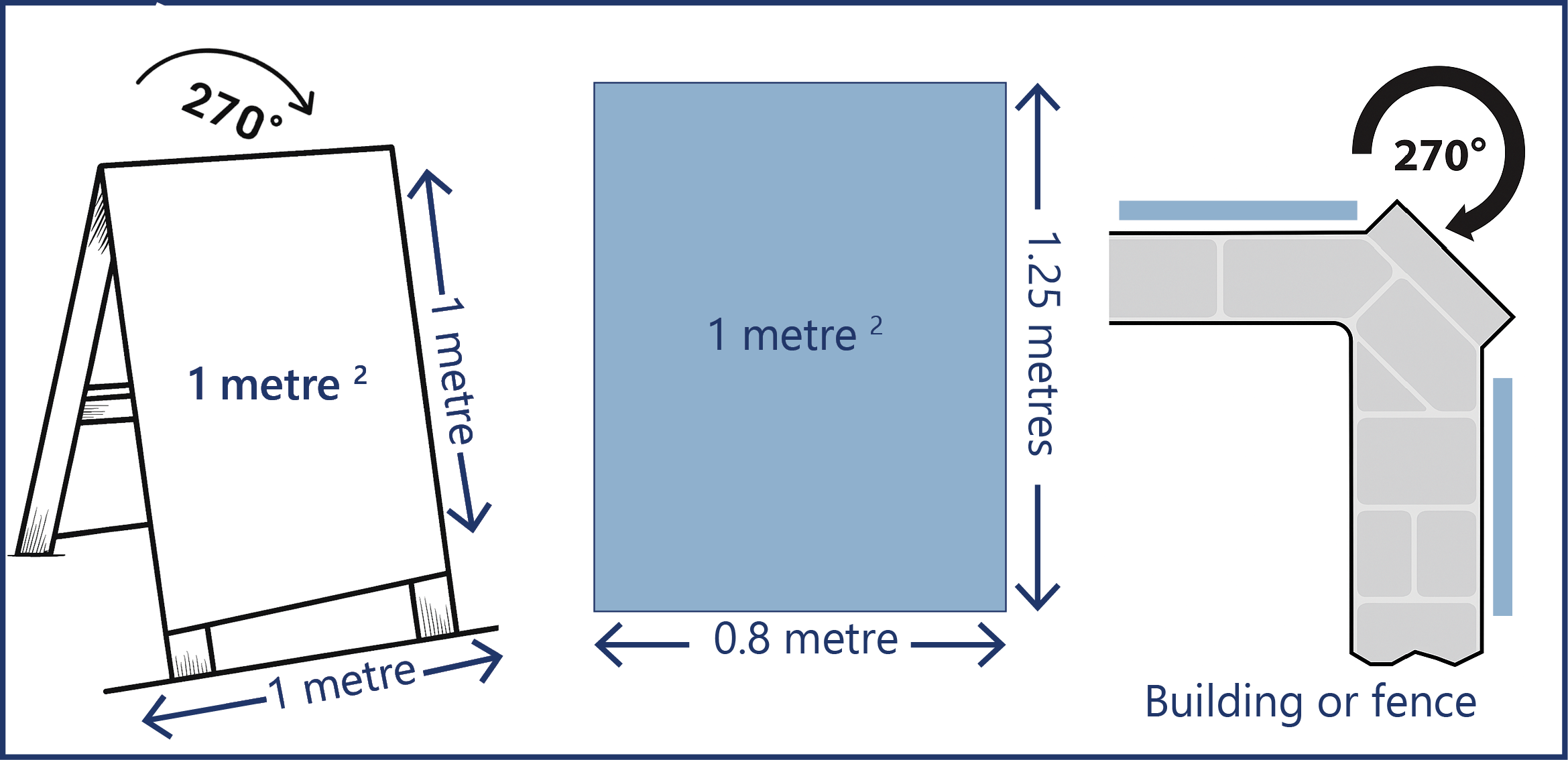
- Advertisements on vehicles, buildings, hoardings, or structures must not exceed 1 square metre.
- Advertisements within 1 metre of each other for the same candidate or party are treated as a single advertisement.
Penalty: Up to $5,000.
Prohibited locations
- It is prohibited to exhibit electoral advertising posters on public roads or road-related areas, including structures, fixtures, or vegetation.
Penalty: Up to $5,000.
Exceptions
- Posters held by a person (directly or attached to a device).
- Posters not attached to a structure, displayed at or near a designated event or activity immediately before, during, or after (maximum 6 hours).
- Posters of a prescribed kind or in prescribed circumstances under regulations.
Compliance note: Significant penalties apply for breaches of size and placement rules under section 115.
Enquiries about the placement of signs in public spaces (e.g. height, location) should be directed to the relevant council, as these matters fall under the Local Government Act 1999.
Headings on electoral advertisements
Part 13, Division 2 of the Electoral Act.
All electoral advertisements must clearly identify the candidate or party they promote. Headings should not mislead voters about the source or purpose of the advertisement.
Misleading advertising
Under section 113 of the Electoral Act, it is an offence to publish electoral material that contains statements of fact that are inaccurate and misleading to a material extent.
Maximum penalty: $5,000 for individuals, $25,000 for bodies corporate.
The Electoral Commissioner may require withdrawal or publication of a retraction.
How-to-vote cards
Part 6 of the Electoral Regulations.
How-to-vote cards must comply with authorisation requirements and must not mislead voters. They should clearly indicate the candidate or party issuing the card and follow the official ballot format.
👉 Learn more on our How-to-Vote Cards page
👉 How-to-Vote Cards Information Sheet (PDF, 514KB)
Broadcast media authorisations
Section 112 of the Electoral Act and the 'Guidelines for the broadcast of political matter' (Australian Communications and Media Authority (ACMA)).
- Radio advertisements must include a spoken authorisation at the end of the advertisement. This format requirement is governed by federal broadcasting regulations, including the Broadcasting Services Act 1992 and ACMA guidelines.
- Television advertisements must include both a spoken and a text-based authorisation at the end of the advertisement. Also governed by federal broadcasting regulations.
While section 112 of the Electoral Act outlines the content of the authorisation (i.e., what must be included), the formatting requirements for broadcast media are set by federal law and apply nationally, including in South Australia.
Digital advertising
Online and social media advertising must comply with authorisation requirements. Paid digital ads may be subject to additional disclosure obligations under the Electoral Act.
Artificially generated electoral advertising
Under section 115B of the Electoral Act, it is prohibited to publish or distribute electoral advertising generated by artificial intelligence that depicts a simulated person performing an act the real person did not perform.
Under section 115C of the Electoral Act, an advertisement generated by artificial intelligence must include a statement that the advertisement is a prescribed artificially generated electoral advertisement.
Maximum penalty: $5,000 for individuals, $10,000 for bodies corporate.
The Electoral Commissioner may request withdrawal of any offending advertising and require a corrective statement.
On this page
Forms and guides - compliance
Used for registration, funding, disclosure, and ongoing obligations under the Electoral Act 1985.
Forms
- Annual Political Expenditure Return (PDF, 1.7MB)
- Associated Entity Details (PDF, 2MB)
- Associated Entity Return (PDF, 2.2MB)
- Audit Certificate – Expenditure (PDF, 1.8MB)
- Audit Certificate – Returns (PDF, 1.5MB)
- 130Q Certificate – General Entitlement to Funds (PDF, 1.9MB)
- Capped Expenditure Period Return – Candidate or Group (PDF, 1.5MB)
- Capped Expenditure Period Return – Registered Political Party (PDF, 2.1MB)
- Capped Expenditure Period Return – Third Party (PDF, 1.5MB)
- Donor Return – Donations or Loans to an Entitled Candidate or Group (PDF, 1.7MB)
- Donor Return – Donations to an Entitled Registered Political Party (PDF, 3.9MB)
- Donor Return – Donations to a Third Party (PDF, 3.9MB)
- Political Party Return (PDF, 2MB)
- State Campaign Account Notification (PDF, 1.9MB)
- Third Party Registration (PDF, 2MB)
- Third Party Return (PDF, 4.4MB)
Guides
- Administrative Funding Guide (PDF, 241KB)
- Advance Funding Guide (PDF, 293KB)
- Funding and Disclosure – General Concepts Guide (PDF, 515KB)
- Policy Development Funding Guide (PDF, 186KB)
- Prescribed Details Guide (PDF, 273KB)
- Public Funding Guide (PDF, 230KB)
Forms and guides - election
Forms and guides for the 2030 State Election will be made available closer to the election period. Please check back for updates as the event approaches.
Information sheets
- Agents (PDF, 426KB)
- Associated Entities (PDF, 1.9MB)
- Compliance Key Dates ALL – 2026 State Election (PDF, 160KB)
- Disclosure of Political Expenditure (PDF, 450KB)
- Election Signage at Polling Places (PDF, 1.1MB)
- Electoral Advertising (PDF, 437KB)
- Expenditure Caps for Election Participants (PDF, 425KB)
- How-to-Vote Cards (PDF, 514KB)
- State Campaign Accounts (PDF, 511KB)
- Third Parties (PDF, 305KB)
If you are unable to locate a specific form or have urgent compliance requirements, contact the Compliance Branch at
Definition of a third party
Under Part 13A, section 130A of the Electoral Act 1985 (the Act), a third party is any individual or organisation (other than those specifically excluded) that either:
- incurs, or intends to incur, more than $10,000 in political expenditure during the designated election period; or
- incurred more than $10,000 in political expenditure during the designated period for the previous general election.
A third party must not incur more than $10,000 in political expenditure during the designated period unless registered under Division 8A of the Act.
Entities excluded from registration
The following are excluded from registration requirements:
- Members of Parliament (House of Assembly or Legislative Council)
- Government or public sector agencies
- Registered political parties, candidates, or groups
- Broadcasters or datacasters
- Publishers of journals (including online publications).
👉 Learn more about third parties, including registration information, on our dedicated third parties page.
Third-party registrations
| Name of third party | Business address | ABN/ACN | Agent | Date of registration |
| Australia Life Pty Ltd | Level 4, 110 George Street PARRAMATTA NSW 2150 |
37 673 056 936 | Joanna Howe | 31/12/2025 |
| Australian Christian Lobby | Level 1, 18 National Circuit BARTON ACT 2600 |
40 075 120 517 | Ashlyn Vice | 21/01/2026 |
| Australian Education Union (SA) | 163 Greenhill Road PARKSIDE SA 5063 |
25 541 678 478 | 23/02/2026 | |
| Christopher Pyne | Level 23, 91 King William Street ADELAIDE SA 5000 |
Christopher Pyne | 23/01/2026 | |
| GetUp Limited | Suite 25/Level 1, 285a Crown Street SURRY HILLS NSW 2010 |
99 114 027 986 | Lachlan McKimmie | 9/02/2026 |
| Retail Safety Alliance | 91 King William Street ADELAIDE SA 5000 |
28 682 985 093 | Tully Smith | 06/03/2026 |
| Rewiring Australia Research and Advocacy Limited | Suite 517/55 Miller Street PYRMONT NSW 2009 |
18 664 239 196 | Timothy Baxter | 20/02/2026 |
| Royal Australian College of General Practitioners | 123 Greenhill Road UNLEY SA 5061 |
33 000 223 807 | Georgina van de Water | 16/02/2026 |
| Royal Automobile Association of South Australia Limited | 101 Richmond Road MILE END SOUTH SA 5031 |
90 020 001 807 | David Colmer | 22/01/2026 |
| Shop Distributive and Allied Employees Association (SDA) SA Branch | 69 Fullarton Road KENT TOWN SA 5067 |
Joshua Peak | 18/04/2022 | |
| Turning Point Australia | Suite 3001/376 Bay Street BRIGHTON LE-SANDS NSW 2216 |
56 664 782 003 | Joel Jammal | 15/01/2026 |
| United Trades and Labour Council of South Australia (SA Unions) | 254 Waymouth Street ADELAIDE SA 5000 |
49 207 741 085 | Dale Beasley | 18/04/2022 |